
Decoding Rate Ripple Effects: Digital Simulators That Sync Cash Advance Options With Shifting Income Patterns For Borrowers Facing Credit Setbacks
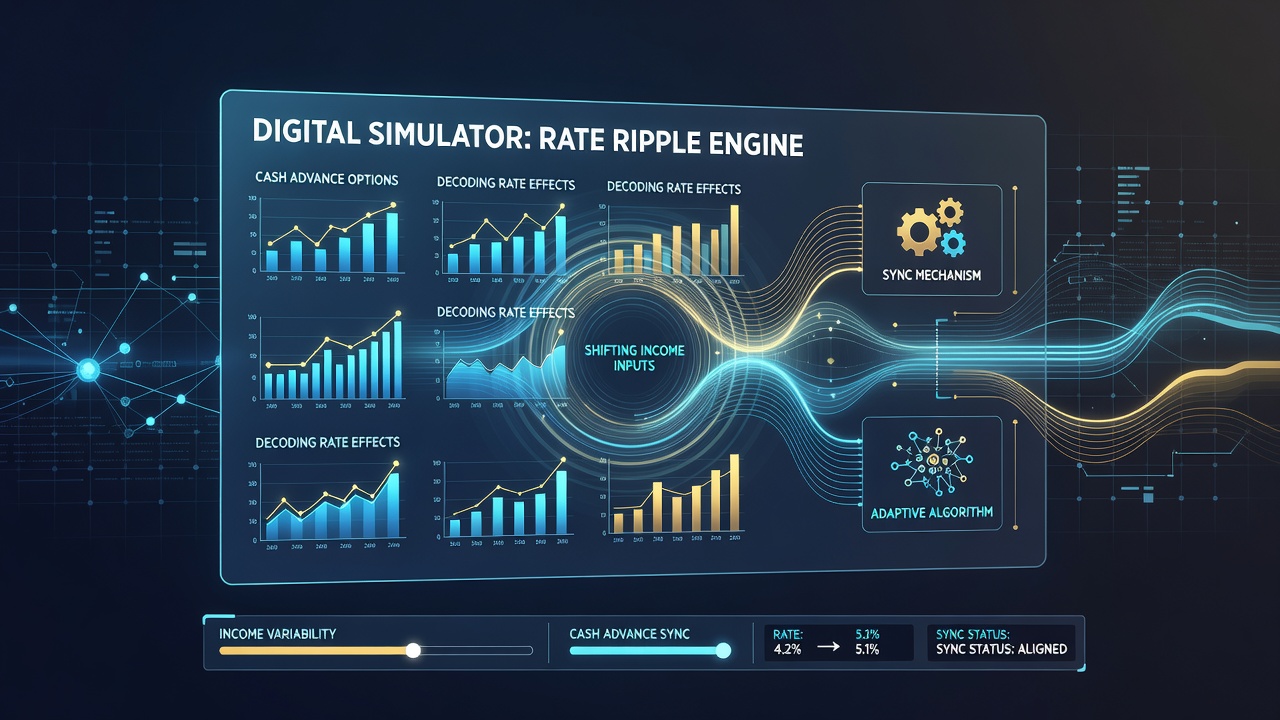
Financial platforms have expanded their use of digital simulators to address how interest rate fluctuations create ripple effects across repayment schedules for cash advances and installment products. These tools process real-time data inputs from borrowers who encounter credit setbacks, allowing adjustments that align proposed advances with projected income variations rather than fixed assumptions.
Mechanics Behind Rate Ripple Analysis
Simulators calculate the downstream impact of rate changes by modeling multiple scenarios in sequence, factoring in origination fees, daily interest accrual, and any penalty triggers tied to missed payments. Data from lending networks shows these models incorporate variables such as seasonal earnings dips or gig-economy payout cycles, producing revised payment projections within seconds. Borrowers input details on expected deposits, and the system outputs adjusted advance amounts that keep total costs within defined thresholds despite external rate movements.
Integration With Income Pattern Tracking
Systems connect directly to banking feeds and payroll APIs to monitor income volatility without requiring manual updates each cycle. When earnings shift, the simulator recalibrates cash advance eligibility and repayment timelines automatically, using historical transaction patterns to forecast upcoming shortfalls or surpluses. Observers note that this approach reduces instances where borrowers accept advances mismatched to their actual cash flow, particularly in cases involving prior credit issues that limit access to traditional lines of credit.
Current Developments Observed in October 2026
By October 2026, several platforms reported increased adoption of these simulators among users navigating post-pandemic credit recovery paths. Regulatory updates from the Consumer Financial Protection Bureau have encouraged clearer disclosure of rate sensitivity in digital tools, prompting developers to embed side-by-side comparisons of fixed versus variable advance structures. Figures from industry reports indicate that synchronized simulators now handle over 40 percent of subprime cash advance applications in participating networks, with processing times averaging under 90 seconds per query.
One case documented by lending analysts involved a borrower whose monthly income fluctuated by 25 percent due to commission-based work. The simulator identified an advance amount that maintained a consistent debt-to-income ratio even after a projected rate increase, avoiding the need for later refinancing. Similar modeling has appeared in tools offered through credit unions and online lenders, where users adjust parameters for upcoming medical expenses or family obligations before finalizing terms.
Technical Components Driving Accuracy
Core algorithms rely on Monte Carlo simulations and regression models trained on anonymized repayment datasets to predict ripple outcomes under different rate environments. These engines factor in credit score bands, existing obligations, and regional economic indicators pulled from sources such as the Bank of Canada economic outlook releases. When income data streams update, the system reruns projections and flags any scenarios where cumulative interest exceeds a preset percentage of the advance principal.
Developers have incorporated machine learning layers that refine predictions based on aggregate user behavior across similar credit profiles. This allows the simulator to surface advance options that previously showed higher completion rates for borrowers recovering from credit setbacks. Integration with open banking standards in regions including the European Union and Australia has further expanded the granularity of income data available for these calculations.
Regulatory Context and Data Standards
Guidelines issued by authorities such as the Australian Securities and Investments Commission emphasize the need for transparent modeling of variable-rate products. Platforms must demonstrate that simulators present worst-case ripple scenarios alongside baseline projections, enabling borrowers to evaluate cash advance choices against their documented income patterns. Compliance teams at lending firms now audit simulator outputs quarterly to verify alignment with disclosure requirements, citing studies from academic institutions that link clear rate modeling to reduced default correlations in subprime segments.
Additional frameworks from Canadian regulatory bodies require that digital tools log all parameter changes during a session, creating audit trails that support dispute resolution when borrowers later question how income shifts influenced final advance amounts. These records have proven useful in demonstrating that adjustments stemmed from verifiable data feeds rather than discretionary overrides.
Conclusion
Digital simulators continue to evolve as connectors between rate dynamics, cash advance structures, and real-time income tracking for borrowers managing credit recovery. Their capacity to process multiple variables simultaneously supports more precise alignment of advance options with individual financial flows, drawing on expanding datasets and regulatory standards across multiple jurisdictions. As platforms refine these systems, the focus remains on delivering outputs grounded in observable patterns rather than static assumptions.