
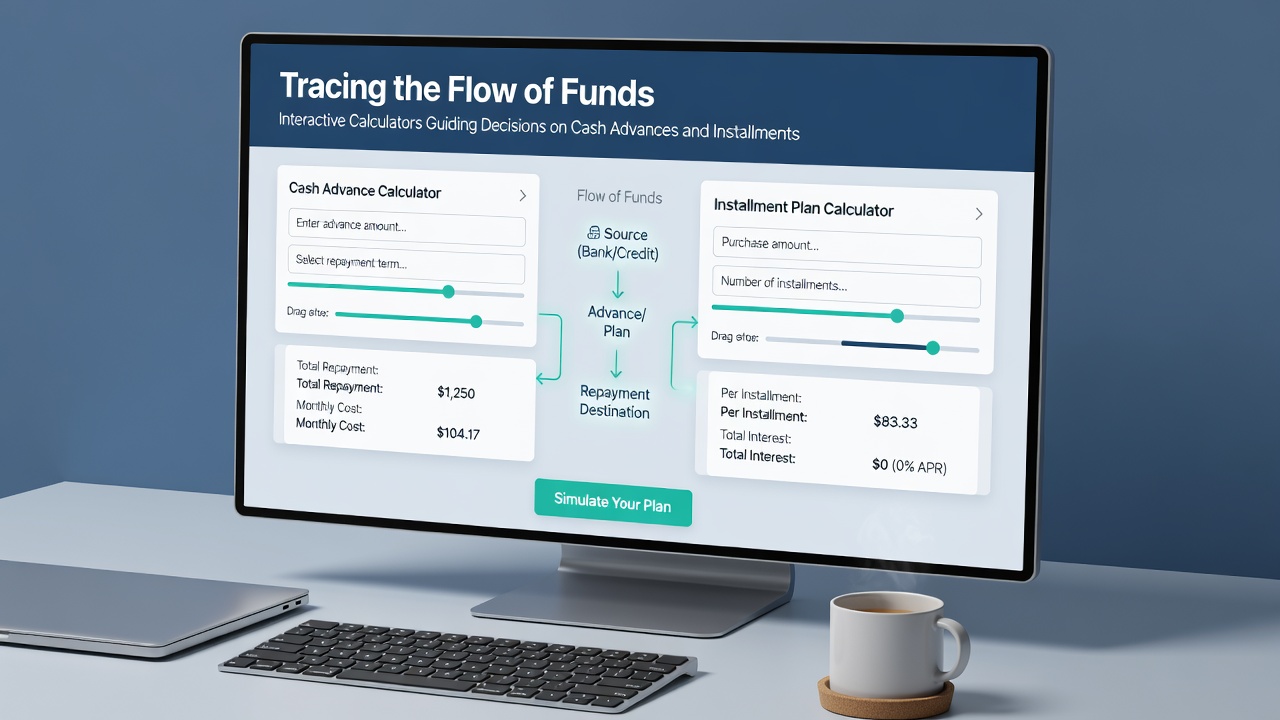
Tracing the Flow of Funds: Interactive Calculators Guiding Decisions on Cash Advances and Installment Structures
Financial tools that map payment trajectories have gained traction among borrowers evaluating short-term advances against longer-term installment options, and these digital models allow users to input variables such as principal amounts, interest rates, and repayment timelines while generating projections that reveal cumulative costs over multiple periods. Observers note that such calculators simulate cash movement from initial disbursement through successive payments, highlighting how early fees in advances can compound differently than fixed installments spread across months or years. Data from lending platforms shows increased usage of these resources during periods of economic adjustment, particularly as borrowers seek clarity on total outlays before committing to any structure.
Mechanics Behind Flow Visualization
Interactive calculators operate by breaking down each transaction into sequential stages where users adjust parameters like loan duration or fee structures, and the software recalculates outflows accordingly, producing side-by-side comparisons that illustrate differences in interest accrual between lump-sum cash advances and amortized installments. Researchers at academic institutions have documented how these systems incorporate compound formulas that factor in daily or monthly rates, enabling precise tracking of fund depletion from borrower accounts over time. In September 2026 regulatory updates from the Consumer Financial Protection Bureau prompted several platforms to integrate enhanced disclosure fields, ensuring projections include ancillary charges that affect overall repayment velocity.
Comparative Analysis Across Loan Types
Cash advances typically feature brief repayment windows with elevated fees that accelerate fund movement out of accounts quickly, whereas installment structures distribute obligations across extended schedules that moderate monthly impacts yet extend total interest exposure. Calculators guide these evaluations by modeling scenarios where a borrower might repay a $500 advance within two weeks versus converting it into a six-month installment plan, and outputs demonstrate how principal reduction rates vary under each approach. Figures from the European Banking Authority indicate that borrowers in multiple member states increasingly rely on such modeling to align repayment alignments with income cycles, reducing mismatches that historically led to repeated borrowing cycles.
Those who've studied lending patterns observe that visualization features within these tools often employ charts tracing cumulative payments against remaining balances, and this approach helps clarify why certain structures preserve more discretionary funds in early months while others front-load costs. Data indicates that users who engage these calculators before selecting products report fewer instances of mismatched expectations regarding payoff dates.
Regional Data Trends and Platform Adaptations
Platforms serving subprime segments have expanded calculator functionality to accommodate regional regulations, with adaptations in Canada reflecting guidance from the Financial Consumer Agency that emphasizes transparent total-cost displays. In September 2026 several North American lenders updated their interfaces to include inflation-adjusted projections, allowing users to factor broader economic variables into cash flow simulations. Academic reports from Australian universities have examined how these tools influence decision speed, finding that visual flow representations correlate with more deliberate selection of installment options when advance fees exceed certain thresholds.
Industry organizations tracking digital adoption note that integration of mobile-friendly calculators has broadened access, enabling real-time adjustments during consultations with loan officers. What's interesting is how these systems sometimes incorporate historical payment data from user profiles to refine projections, though privacy controls limit such personalization in many jurisdictions. Evidence suggests that borrowers facing variable income streams benefit particularly from the ability to test multiple installment lengths against projected cash inflows.
Impact on Decision Processes
Calculators reshape how individuals assess risk by quantifying the velocity of fund transfers, and this quantification supports comparisons where one option drains resources faster in the short term while the other maintains steadier outflows. Trade groups representing fintech developers have reported rising demand for customizable modules that accommodate irregular payment schedules common in gig economies. According to analyses from the Bank of Canada, such tools contribute to improved alignment between borrowing choices and household cash management practices across diverse borrower profiles.
Conclusion
Interactive calculators continue to evolve as instruments for mapping fund trajectories in cash advance and installment contexts, supplying borrowers with granular projections that inform structural selections without prescribing outcomes. Ongoing refinements tied to regulatory timelines, including those observed in September 2026, sustain their relevance amid shifting lending landscapes. Data from multiple oversight bodies underscores their role in clarifying cost differentials, thereby supporting more measured evaluations of repayment obligations across varied time horizons.